
Tedua, Izi and the Cogoleto of Wild Bandana
Mario Molinari and Diego Germini grew up here. Together with Vaz Tè, Ill Rave, Sangue and Guesan they built one of the most influential Italian rap collectives of the last decade — starting from a middle-school classroom in the province of Genoa.
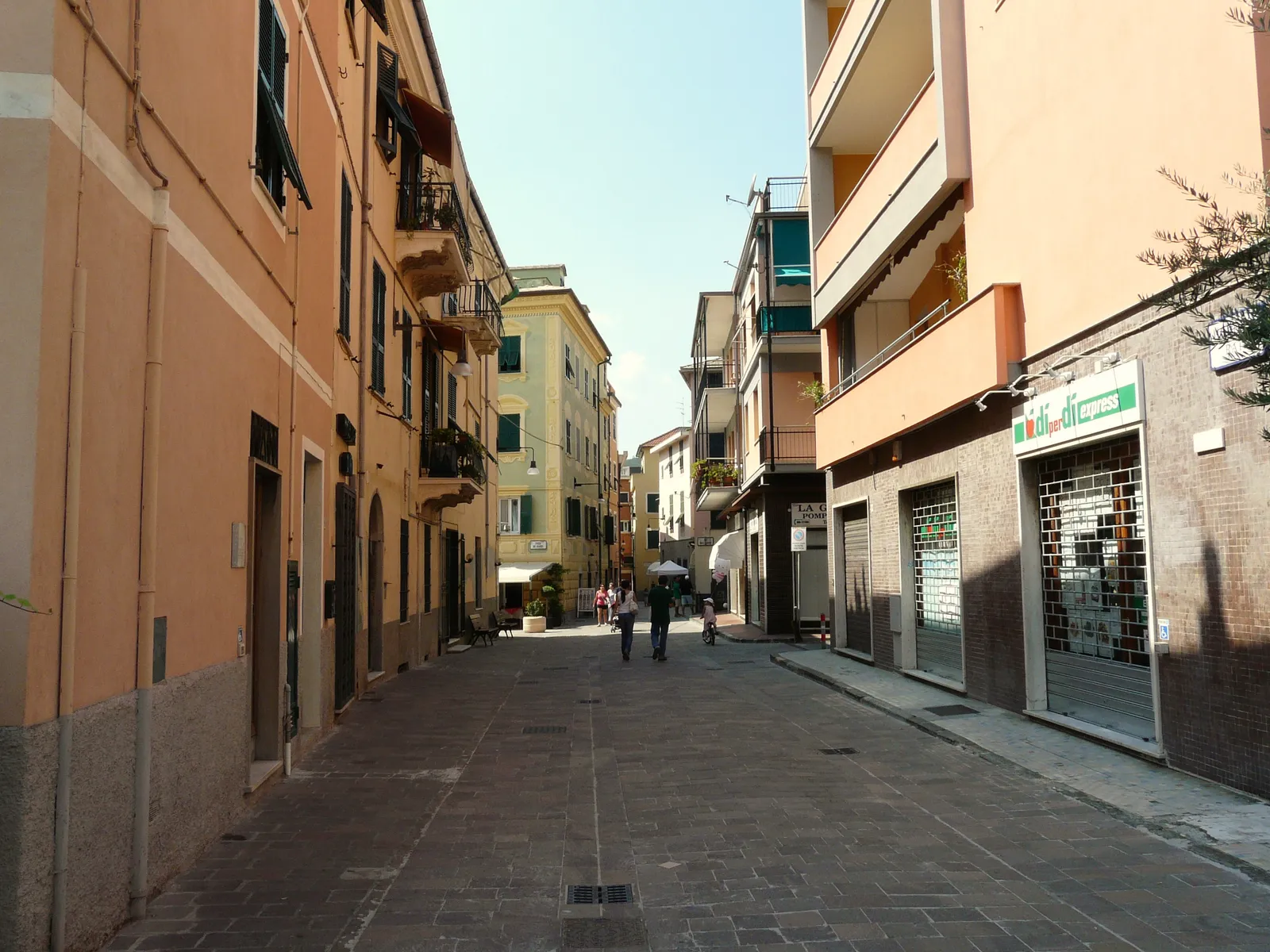
From the outside Cogoleto is three kilometres of seafront, a square, a bell tower and a handful of bars selling focaccia until ten at night. Spend a weekend here and you won’t notice anything. And yet a sizeable chunk of what Italians now call the “new Italian rap school” came out of this town: not in some literary sense, in a literal biographical one. Mario Molinari and Diego Germini, better known as Tedua and Izi, grew up here, for years, walking the same streets the pushchairs now roll along on Sunday mornings.
There are no plaques. There are no murals with their faces. The town hall has never granted either of them honorary citizenship. And yet the link is well documented: in their own interviews, on Wikipedia, in everything the Italian music press has written about the Genoese rap scene over the past decade. Worth a quick tour, even if rap isn’t your thing.
Two kids, one middle school
Mario Molinari was born in Genoa on 21 February 1994. His childhood was fragmented: some years in foster care in Milan, then back to Liguria. In a long Rolling Stone Italia interview he describes how his mother eventually brought him to the province of Genoa with her new partner: first to Arenzano, then to Cogoleto, “where the rent was cheaper”. “That became my home town for eight years,” he says. Eight years, roughly from thirteen to twenty-one: the formative ones, when you learn an accent, a dialect, where to order coffee, who to trust.
In the same interview he describes what it meant to be the kid with the Milanese accent in a Ligurian town: “inept” to the locals, mocked at school, “discriminated against by classmates and even by teachers because of his family history”. And also: “neighbourhood life, the stadium, boxing, the sea, and conversations with sketchy characters at the bar gave him substance”. The sea, the bars, the boxing gym are his words.
At school, according to Wikipedia and Vice’s reconstruction, Mario met a classmate at the age of thirteen who would become Vaz Tè. Through him he then met “his fellow townsman Izi”, literally the kid from the same town. Diego Germini was born in Savigliano (Cuneo) on 30 July 1995, but he grew up in Cogoleto. One year apart, they walked the same streets and did the same thing in their bedrooms: writing lines.
One small correction is worth making, because Italian outlets have routinely fudged it. Vaz Tè (Alessandro Guzzo) is not from Cogoleto: he grew up between Pra’ and Palmaro, on Genoa’s western fringe. The exact school where he and Tedua met has never been named publicly. The Cogoleto core of Wild Bandana, strictly speaking, is Tedua and Izi; Vaz Tè is the piece that arrived on the Genova–Ventimiglia train line.
What Wild Bandana actually is
Wild Bandana is a collective, not a group. The distinction matters: they don’t release albums under the name “Wild Bandana”; they release solo records and feature each other, produce for each other, share a studio. The classic line-up is Tedua, Izi, Vaz Tè, Ill Rave (from Voltri), Sangue and Guesan, with a wider orbit: Bresh (from Bogliasco), Nader Shah, Disme (from La Spezia).
The name comes from a 2017 Izi track featuring Tedua and Vaz Tè that tells their story autobiographically. Before the name there was a place: “Studio Ostile” in Genoa, where from around 2012 the crew would meet most afternoons to record. The collective moment came in 2017 with Amici Miei Mixtape, a group record made (Vice reports) in a studio Tedua rented with money from the Orange County: California distribution deal. Almost no pre-written lyrics, a lot of freestyle, a lot of late nights.
The solo careers grew from there, and the numbers turned serious:
- Tedua released Orange County California (2017, 6× Platinum), Mowgli – Il Disco della Giungla (2018, 3× Platinum, number one), Vita Vera Mixtape (2020) and La Divina Commedia (2023, 7× Platinum, number one). Labels: Thaurus, Sony, Epic.
- Izi released Fenice (2016), Pizzicato (2017), Aletheia (2019), Riot (2020), plus a 2023 Sanremo Festival duet with Madame on a Fabrizio De André composition.
These are mainstream-artist numbers, not niche-scene numbers. What the national press took a while to register is that behind those records sits a Ligurian centre of gravity, and for two of the principal names that centre is, precisely, this town.
Cogoleto in the lyrics
A little care is needed here. Neither rapper names Piazza Giusti, the church of San Maurizio or any other identifiable Cogoleto landmark in their lyrics. The Ligurian sea runs through hundreds of Italian songs, and no one really gets to claim it.
What is documented is Tedua’s single “Polvere”, which the music press has explicitly framed as “uniting the sound of Cogoleto with that of Salerno”, Salerno via the Campanian production team. That is the proof that the personal geography, even when it doesn’t appear in the lines themselves, gets claimed in interviews and in the way the record is sold.
The wider acknowledgement came with the 2022 documentary “La nuova scuola genovese” (The New Genoese School), directed by Yuri Dellacasa and Paolo Fossati. It puts the great Genoese songwriting tradition (Paoli, Tenco, Bindi, Lauzi, De André) in conversation with the Ligurian rappers now dominating the Italian charts. Tedua is filmed sitting opposite Gino Paoli; Izi visits the De André Foundation to talk with Dori Ghezzi, Faber’s widow; Bresh meets Cristiano De André. That documentary is, in effect, the formal moment Genoa recognised these artists as the next link in a chain that runs back to the singer-songwriter golden age.
Places they pass through
Live shows in Cogoleto? None, basically. Neither Tedua nor Izi have ever played here: their tours are arenas and stadiums (Tedua closes the tenth-anniversary cycle of Aspettando Orange County with a one-off at San Siro in Milan on 24 June 2026, billed simply “San Siro Tedua”). For them this place is somewhere to spend August, not a stage.
The most symbolic return so far came at Sanremo 2025, when Tedua performed on the Suzuki Stage in Piazza Colombo and duetted with Domitilla Abeasis, a 21-year-old singer from Arenzano, the town immediately west of Cogoleto. The local paper Cronache Ponentine ran the headline without irony: “Arenzano and Cogoleto at Sanremo too.” For someone who spent eight teenage years here, duetting at Italy’s biggest music festival with the girl from the next town along is a circle closing quietly.
Where to start listening
If you’ve never heard them and you’re curious to understand what’s going on, three doors in:
- Tedua — Mowgli – Il Disco della Giungla (2018). The album that broke him. The concept is the urban jungle filtered through Mowgli; the drill influences are there but digested, not name-checked.
- Izi — Fenice (2016). The first album. More melodic, closer to the Genoese songwriting tradition that Dori Ghezzi would later sit down to discuss with him on camera.
- Wild Bandana — Amici Miei Mixtape (2017). The only true collective document. Rough around the edges, and honest for that reason.
After that, the deep end: Tedua’s La Divina Commedia (2023) is arguably the most ambitious Italian rap album of the decade. Seven times platinum, with a Dantean narrative scaffold that holds up past the surface gimmick the cover suggests.
None of this turns Cogoleto into a pilgrimage site. There will never be a Tedua Tour of the town, and that’s fine. It’s enough to know that when you walk past the middle school and hear teenagers trading a rhyme, there’s a non-trivial historical chance the same gesture has worked here once before.
Leggi questo articolo in italiano: tedua izi wild bandana.
In summer: ice cream or granita?
Tap your favourite to vote.
Tap your favourite to vote and see the results.
All polls