
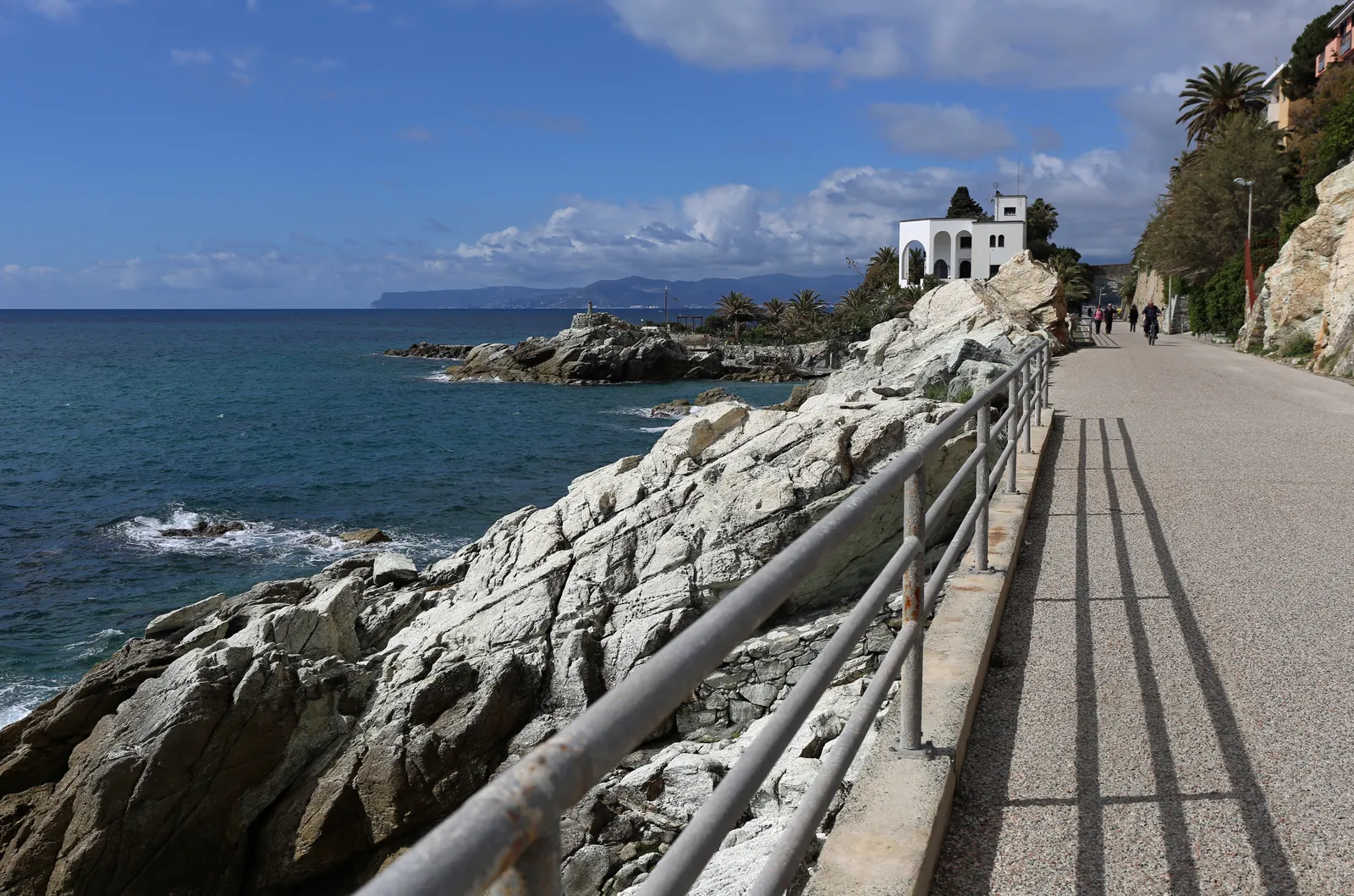
The coastal cycle path on the old railway: 11.87 km from Arenzano to Varazze
Built on the trackbed of the Genoa-Ventimiglia railway abandoned in 1968, it threads through tunnels carved into the cliff and hugs the sea for almost its entire length.
You come out of the tunnel and the light hits you sideways, and for a couple of seconds you can’t quite tell whether you’re cycling over the sea or inside it. It’s a feeling that keeps coming back: there are five or six tunnels on this path, depending on where you start from, and each one delivers you to the world in a slightly different way. The pedestrian and cycle track connecting Arenzano to Varazze through Cogoleto is one of the simplest, most successful things Liguria has ever done with its coastline: eleven kilometres and eight hundred and seventy metres of old railway turned into a promenade, always above the water, always flat, always open.
The route in numbers
The full path is 11.87 km, split into two segments that meet in the centre of Cogoleto. The first, Arenzano to Cogoleto, runs about 4.5 km; the second, Cogoleto to Varazze, is locally called Lungomare Europa and covers 5.8 km. Cumulative ascent is just 165 metres with the same in descent: essentially nothing, a handful of short ramps the road surface tucks away beneath its own continuity.
The surface is asphalt end to end (Parco del Beigua lists the trail as 100% paved), smooth enough for a road bike and forgiving for a city bike, a stroller, a pair of inline skates. There isn’t a metre of gravel. A yellow line down the middle separates cyclists from pedestrians, a convention respected with varying success on July weekends.
The story behind the railway
To understand why this path exists at all you have to go back to 1968, when the Genoa-Ventimiglia railway line was rerouted inland. Until then the trains ran exactly here, an arm’s length from the waves, through tunnels carved into the friable rock of the hillside. The reasons were twofold: doubling the track (impossible on the coastal shelf, too narrow) and moving the noise away from the houses. The old line was abandoned, the rails ripped up, the tunnels sealed. For a good thirty years that’s how it stayed: low walls, brambles, the occasional shore fisherman climbing down at the foot of the embankment.
Then, in stages (first the Varazze-Cogoleto section, completed in the early 2000s and christened Lungomare Europa, then the extension to Arenzano) the strip was cleaned, paved, lit and reopened. Today it forms the 15th stage of the Sentiero Liguria and sits inside the Beigua UNESCO Geopark. From Cogoleto you can climb inland onto the park’s trail network all the way up to Monte Beigua at 1,287 m. That’s another story, and another day.
The sea tunnels
The tunnels are the path’s signature. The first one, just past Arenzano’s small harbour, is wide and airy, lit by discreet neons; the sixth, near Varazze, is the narrowest, lowest-roofed, and smells of the sea even in winter because salt blows in through the windows cut into the rock face that look straight out onto the water. They are short (the longest is under 200 metres) and all lit, though through summer 2025 the Cogoleto-Varazze section was still on construction-grade floodlights waiting for the permanent fixtures to be restored (Riviera dei Bambini reported this as recently as June). In daylight you ride through without thinking about them; at sunset they become corridors of yellow light reflecting off asphalt damp with salt.
Between one tunnel and the next, the path opens onto small white-pebble coves, some reachable only from the trail itself via stone steps that drop a few metres. Baia dei Corvi, halfway along the Lungomare Europa, is the best-known: the rock changes colour there (the Geopark explains it on a panel: from pale metagabbro to dark serpentinite) and the water takes on that bottle-green that is the trademark of the Beigua coast.
How to ride it well
Recommended direction. East to west, so Varazze → Cogoleto → Arenzano, if you like the sun behind you on the way out and in front of you on the way back. The other way works just as well, but the prevailing summer wind is from the south-west, and taking it head-on at the start is less pleasant than on the return when your legs are already done.
Season. It’s open year-round. The sweet spots are May–June and September–October: right temperature, Mediterranean scrub in full flower (the oleanders along Lungomare Europa bloom into late July), almost no crowds. July and August afternoons are the worst window (you weave between strollers and tourists crossing without looking), but early mornings and evenings after 7pm remain wonderful. In winter it’s perfect when you have an hour: the microclimate shields the coast from the wind, and even in January you can ride in short sleeves.
Family and fitness. Stroller-friendly from first metre to last, and skaters use it regularly (the asphalt is smooth enough for inline skates, less so for quad). Kids manage it from 3-4 upwards, with or without pedals. For runners it’s a 23.7 km out-and-back gym session without a single traffic light.
Rentals. Two reliable addresses. La Mola has two shops at either end of Lungomare Europa, Varazze at via Marconi 14 and Cogoleto at piazza Salvador Allende, with city bikes, MTBs, e-bikes, tandems, rickshaws and over 400 vehicles in total; they also run a one-way service where you pick up in Varazze and drop off in Cogoleto, or vice versa. In Arenzano, at the start of the path near the small marina on Lungomare Stati Uniti, there’s another rental shop open from September to mid-June with continuous weekend hours (Arenzano Turismo).
Train for the way back. The stations at Arenzano, Cogoleto and Varazze are all within 500 metres of the path and sit on the regional Genoa-Savona-Ventimiglia line. The classic loop: rent in Varazze, ride to Arenzano, train back in twelve minutes. Bikes travel free on regional trains with the standard supplement.
Where to refuel
Halfway along Lungomare Europa, 600 metres before the Varazze entrance, there’s a small bar with a wooden deck: outdoor tables hanging over the sea, warm focaccia, gelato. It’s the right place to stop when the sun starts to mean it. On the Cogoleto side, at the path’s terminus, another seafront bar serves lemon granitas and decent coffee.
For something more substantial, drop down into the centre of Cogoleto (two minutes from the path) and look for one of the fishermen’s trattorias along via Rati, or carry on to Varazze whose seafront has a string of historic gelaterias. Honestly though, a standing focaccia at the halfway bar followed by a dip from the cove below is exactly the right thing to do mid-morning, and there’s no need for anything more.
When you ride back late in the afternoon and the sun comes in low through the first tunnel, you understand that this place is one of those rare happy accidents: a railway built where it shouldn’t have been, taken away for the wrong reason, turned into something else in the best possible way.
Leggi questo articolo in italiano: pista ciclabile cogoleto varazze.
In summer: ice cream or granita?
Tap your favourite to vote.
Tap your favourite to vote and see the results.
All polls