
Columbus and Cogoleto: what the sources actually say
The house on Via Rati, a 1650 inscription, a 1638 Mercator atlas — and why most historians still place Christopher Columbus's birth in Genoa.
Honest opening: ask anyone in Cogoleto where Christopher Columbus was born and you’ll be pointed at a house on Via Rati. Open a modern history textbook and it’ll say Genoa. Both things are true in the way most things are usually true. One is supported by nearly five centuries of papers, plaques and frescoes preserved in the village; the other is the position broadly held in academic historiography since the 19th century. This article tries to lay out both versions without hiding anything.
There’s nothing to sell here. The house is still where it has always been, halfway up the old town’s caruggio (a Ligurian word for the narrow alleys that run through these villages). You decide.
Some quick context for foreign readers: Cogoleto is a small Ligurian town about 25 km west of Genoa, on the coast between Arenzano and Varazze. Liguria is the crescent-shaped region of the Italian Riviera. Genoa was, for several centuries, one of the four great Italian maritime republics, and is the city most history books point to as Columbus’s birthplace. The dispute, in other words, is not Italy vs. somewhere else: it’s a small coastal town versus the regional capital twenty kilometres east.
The house on Via Rati 64
Italy has several houses claiming to be Columbus’s birthplace. The Cogoleto one has a feature most others can’t match: it is documented as a residence of the Colombo family in notarial deeds predating the Indies voyages. It stands in the old contrada del Caroggio, the historic alley that runs through the village centre, renamed Via Cristoforo Colombo for a stretch and now Via Rati. The civic number is 64.
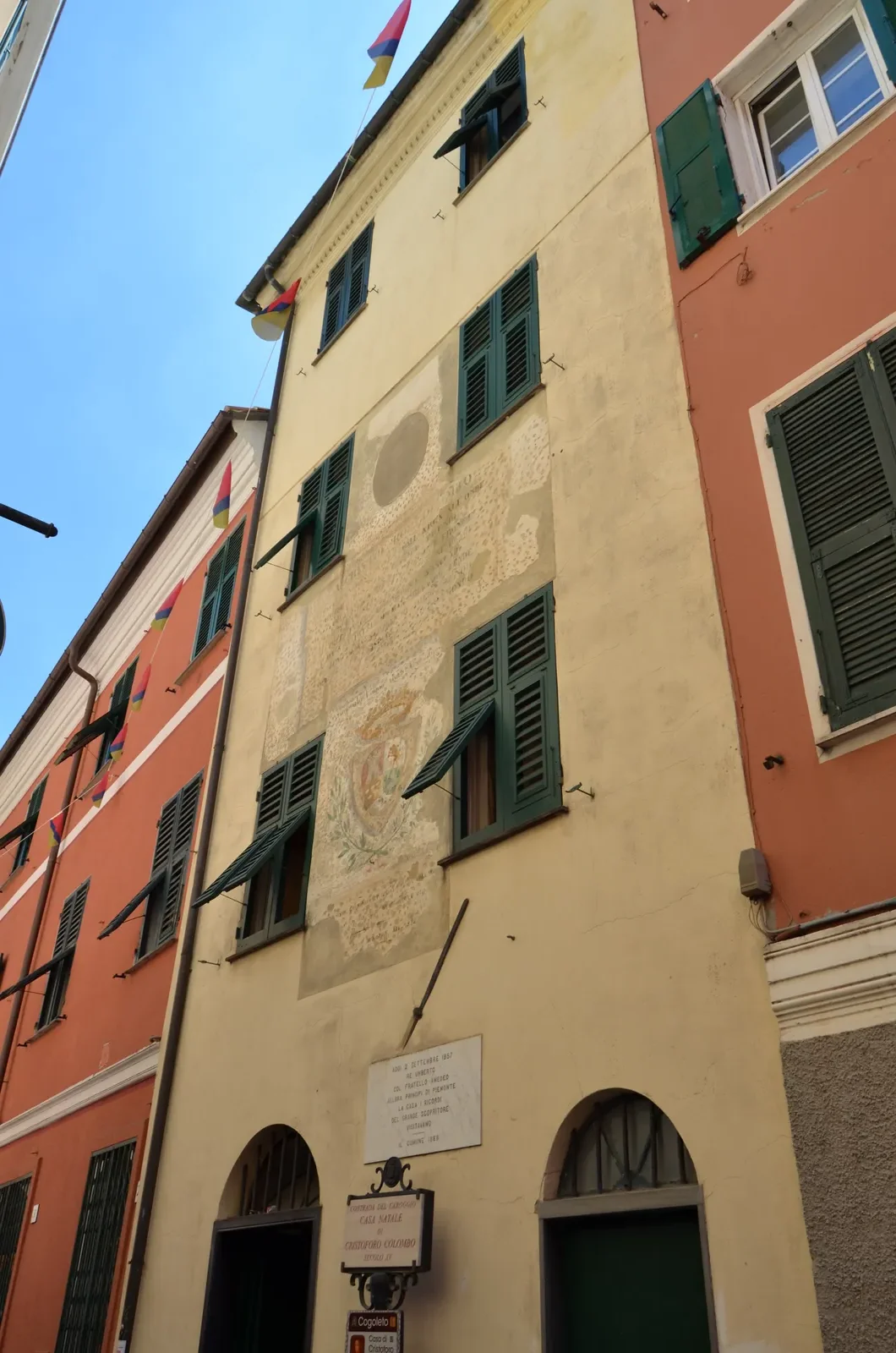
From the street it’s an ordinary old-town house: two or three storeys pressed up against its neighbours, aged plaster, small windows. On the façade you can still make out, faded but legible, a fresco with a coat of arms, a portrait, and a poetic inscription from the 17th century, with a later Latin couplet underneath. The interior is private and lived-in: you can’t go inside. That detail disorients American visitors in particular, who tend to arrive expecting a polished house-museum.
The documents
The local case essentially rests on four pieces.
1. The 1449 will of Domenico Colombo, in a 1586 notarial copy. The original is lost. What survives is an authenticated copy made in 1586 by the notary Antonio Chiodo of Varazze, with seven non-family witnesses, in which Domenico — Columbus’s father in the Cogoleto version — disposes of his property and identifies the family house in the alley. The fact that we have the copy, not the original, is one of the hooks used by those who contest the Cogoleto claim: the document is 16th-century, not 15th.
2. The 1482 power of attorney of Bartolomeo Colombo. More interesting because closer to the events. On 5 September 1482, Bartolomeo Colombo, Christopher’s brother, signed before the notary Conreno Verdino of Varazze a power of attorney executed in the family dwelling in Cogoleto. The deed states explicitly that Domenico is deceased and that Christopher is absent in Spain. Note the date: in 1482, Columbus had not yet discovered anything, and his brother is signing papers from Cogoleto as from his own home.
3. The 1650 façade fresco. In 1650 a parish priest named Antonio Colombo, who claimed descent from the family, had the façade decorated. He commissioned a portrait of the navigator and a verse inscription in Italian: eight lines built around a play on the family name (Colombo means “dove” in Italian) and the Noah’s-ark imagery that goes with it:
Con generoso ardir dall’Arca all’onde Ubbidiente il vol Colomba prende… (With generous daring from the Ark to the waves / Obedient the Dove takes flight…)
The inscription closes with the signature “Li 2 dicembre 1650. Prete Antonio Colombo”. Later, in the 19th century, the philologist Faustino Gagliuffi added a Latin couplet, “Hospes siste gradum: fuit hic lux prima Columbi / Orbe viro majori; Heu! Nimis arcta Domus”, inviting the traveller to pause before “the first light” of Columbus. The façade was then restored in 1872 by the municipality (pilgrims in search of relics had been scraping the walls) and again in 1952, this time with funds raised by Cogoleto emigrants in the Americas, who paid to have the portrait and inscriptions refreshed after they had faded to illegibility.
4. The 1638 Mercator Atlas. In the Amsterdam edition of the Mercator-Hondius Atlas, one of the most widely circulated European atlases of the 17th century, Cogoleto appears on the Ligurian coast labelled in Latin as “Coguretto Christophori Columbi patria”: “Cogoleto, homeland of Christopher Columbus”. For local historians this matters because it’s a non-local source, produced in Holland, showing that by the mid-17th century the tradition was recognised well beyond the village walls.
Taken together, the documents establish one clear thing: in Cogoleto, at least since the 16th century, it was treated as common knowledge that the navigator had been born there. That is not direct proof of his birth; it is solid proof of a tradition far older than the 19th-century arguments about it.
The homonymy theory
The standard objection to the Cogoleto case is blunt: the Genoese archives preserve a series of notarial deeds that reconstruct, with reasonable precision, the family tree of a Cristoforo Colombo born in Genoa around 1451, son of Domenico Colombo and Susanna Fontanarossa, a wool-worker. The academic consensus rests on this material, recovered and published between the 19th and 20th centuries.
How do the two versions fit together? The most commonly proposed reconciliation is the homonymy theory: in the same period, in Liguria, there were two Cristoforo Colombo, both sons of a Domenico. One was Genoese (son of Susanna Fontanarossa), the other Cogoletese (son of a Maria Giusti di Lerca, born around 1436). The Cogoleto documents would refer to the second, the Genoese documents to the first. The overlap of names would have caused centuries of confusion.
The homonymy theory is a hypothesis, not a fact. It explains neatly why Bartolomeo could sign deeds from Cogoleto in 1482 without contradicting the Genoese archives, but it is still a construction designed to reconcile two independent dossiers. Those who reject it argue that the Cogoleto tradition is simply older and independent of the Genoese one, was suppressed by Genoa’s political weight, and that the Genoese notarial file identifies someone else. Those who accept it concede that there really was a Cristoforo Colombo in Cogoleto, just not the Christopher Columbus.
For what it’s worth: in Italian school textbooks, Genoa wins. In specialist works on Ligurian micro-history, the homonymy debate is treated seriously. It is not a closed question.
The bust in Piazza Giusti and the emigrants
One thing worth noticing about Cogoleto’s memory of Columbus is how much of it has been carried by emigration. Between 1839 and 1869, 608 passports were issued from the municipality, almost all of them bound for the Americas: Montevideo and Buenos Aires in the south, New Orleans, New York and Boston in the north. For a community of a few thousand people that is an enormous figure.
For the emigrants the Columbus story was a practical anchor of identity: it gave you a way to present yourself, on the other side of the Atlantic, as part of the same thing that had washed over you on arrival. That isn’t rhetoric. These are the same people who funded, from the diaspora, the commemorations you see in the village today.
The bronze bust of Christopher Columbus in Piazza Giusti, set on the west side of the town hall, is the work of the sculptor Domenico Vassallo and was unveiled on 26 August 1888. The funding is the interesting part: a quadratic marble column supporting the bust, sea-themed decorative elements, and a subscription jointly organised by a committee in Cogoleto and one in Buenos Aires, where the Cogoletese colony had grown substantial. Vassallo had already donated an earlier marble bust to the municipality in 1864; the 1888 bronze comes from the second fundraising round. In the same period (1887) the town adopted as its coat of arms a castle with a dove and the monogram “XP°”, an explicit reference to the navigator.
The two things, American diaspora and Columbus memory, hold each other up. Without the emigration, the 1952 restoration probably wouldn’t have happened; without the 1650 inscription, the emigrants wouldn’t have had a thing to point to.
What to see today
By train: Cogoleto station, on the Genoa–Ventimiglia line, ten minutes on foot from the centre. Walk west along the seafront, take the first turn inland into the old town. You’re in the caruggio.
Via Rati 64 is one of the houses facing onto the alley. Numbering can look a little inconsistent: older tourist signage refers to “no. 28” because that was the civic number before the 20th-century renumbering; the current address is 64. On the façade you’ll see the fresco with coat of arms and portrait, the 1650 inscription in Italian (the priest Antonio Colombo’s eight lines) and, beneath it, Gagliuffi’s Latin couplet. Above the door a marble plaque commemorates the tradition of the birthplace; the wording is careful, not assertive.
The house is lived in: you can’t go inside. Worth remembering before you knock. On the seaward side of the façade there’s another, smaller plaque marking the 1847 visit of the American naval ship Princeton, which called specifically at Cogoleto to see the navigator’s portrait (which, awkwardly, was kept at the town hall and not in the house).
From Via Rati, five minutes’ walk towards the municipality brings you to Piazza Giusti: Vassallo’s bronze bust is there, on its squared column, facing the west wall of the town hall. Neither site, house or bust, offers a structured museum experience. There’s a façade, a square, and a town that has been telling the same story for almost five hundred years.
What you do with that is up to you.
Leggi questo articolo in italiano: colombo cogoleto.
In summer: ice cream or granita?
Tap your favourite to vote.
Tap your favourite to vote and see the results.
All polls